


We help companies build AI features that hold up in production — from AI-powered products and workflow automation to advisory and hands-on team augmentation. Learn more about our AI services →

Date
26 August 2026
Category
AI, DevelopmentGenerative AI in Nordic software delivery: what buyers should watch
If you buy software consultancy in Finland or the wider Nordics, you already hear "we use AI". That stopped being useful in 2025. What matters is how partners use agents, how they review the output, and whether delivery stays stable.

This article was written by:
Matti Dahlbom, Principal Architect
While the use of agentic AI tools has risen greatly among developers, the acceptance of AI usage among customer organisations has skyrocketed during H1 2026. While pre-2026 the consensus for AI usage among customer organisations was careful at best; now it is a requirement for almost every customer.
From copilots to agents: the 2025–2026 shift
Two years ago, genAI in engineering mostly meant chat and autocomplete. In 2025–2026, agents can open files, run commands, write tests, and iterate without a prompt for every step. Stack Overflow already separates classic copilots from agents: many developers still live in autocomplete, while a growing share use agents at work at least monthly.
For a buyer: a partner who pastes chatbot snippets is not the same as one who runs agentic workflows with review gates.
How the tool mix moved
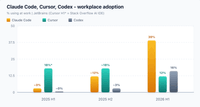
Among Claude Code, Cursor, and Codex, JetBrains “used at work” shares reshuffle fast. Percentages can sum over 100% (multi-tool use). Not Nordic revenue share.
- 2025 H1. Claude Code ~3% at work (Apr–Jun 2025). Cursor already visible: Stack Overflow AI-enabled IDE share ~18%*. Codex ~0%. (JetBrains Apr 2026, Stack Overflow 2025)
- 2025 H2. Claude Code ~12% by Sep 2025 (JetBrains: Jan 2026’s 18% was 1.5× September). By Jan 2026 Claude and Cursor tied at 18%; Codex ~3%. (JetBrains Apr 2026)
- 2026 H1. May–Jul 2026: Claude Code ~39%, Codex ~16%, Cursor ~12% on the same work measure. Leadership moves in half-years—ask for fluency across agents, not last quarter’s logo. (JetBrains Aug 2026)
Figure 1. Workplace adoption of primary agentic AI tools 2025-2026
What the numbers say
Global surveys and vendor reports are a direction, not a Nordic census.
Authorship at the toolmakers
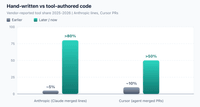
Anthropic: Claude’s share of merged production lines rose from low single digits before Feb 2025 Claude Code preview to more than 80% by May 2026.
Cursor: Cloud agents authored ~1 in 10 merged monorepo PRs in Dec 2025, then more than half by Jul 2026. Metrics differ (lines vs PRs); these are vendor-internal repos. Ask partners for their review gates—not a vendor ceiling.
Figure 2. Tool-authored share: Anthropic Claude merged lines ~5% → >80%; Cursor agent merged PRs ~10% → >50%. “Earlier” refers to pre-2026; “Later / now” refers to the agentic AI era (post-2026).
Trust & quality
DORA 2025 links AI adoption to higher throughput but still to lower delivery stability. More Stack Overflow respondents distrust AI accuracy (46%) than trust it (~33%). A METR RCT found experienced open-source developers took ~19% longer with early-2025 AI tools, even when they felt faster. Velocity without review ships risk.
These metrics have improved greatly with the agentic AI era.
Buying consultancy when agents write the code
Purchasing criteria change when agents draft code and UI. A logo on a slide is not a delivery model. Ask how work runs end to end—from requirements through design and build to review and deploy—with agents in the loop.
Look for a shared project memory: rules for what agents may do, current state, sources and approved decisions, what is delegated versus human-gated, and how learnings are kept. Without that, agent output drifts.
Ask who owns architecture and product judgment, who reviews merges, and which tests and CI gates catch issues before they ship. Cutting junior hours only works if senior review capacity grows with agent throughput.
Agents help teams explore more variants and ship drafts faster—sometimes work that would not happen at the same scale without them. They also raise stability risk and false confidence in speed, as the delivery numbers above suggest. Track cycle time, change failure, and rework—not “% of code written by AI.”
Do: demand review gates and CI before merge; name architecture ownership; measure outcomes; expect fluency across agents, not one vendor.
Don’t: buy “we use AI”; chase last quarter’s logo; treat draft volume as progress; skip data, IP, and tooling-policy questions.
A strong partner directs agents; they do not outsource judgment.
AI in daily work
We use the primary genAI tools Claude Code, Cursor AI and Codex in our daily work throughout our design and software engineering departments. And we are not strangers to Co-pilot either! After all, the primary agentic tools are mostly interchangeable and can easily be used together while working on a project.
While we provide a suggestion for tooling per project, the final word on tool selection always comes down to the customer’s preferences.
One recent example is our work with Finnpark, a Finnish parking company, where a new payment terminal went from kickoff to production in just eight weeks. AI agents handled most of the coding, while our team focused on requirements, quality, and decision-making.
References
- Stack Overflow: 2025 Developer Survey — AI
- JetBrains: Which AI Coding Tools Do Developers Actually Use at Work?
- JetBrains: AI Coding Agents: Adoption Trends
- Google Cloud / DORA: Announcing the 2025 DORA Report
- Anthropic Institute: When AI builds itself
- Cursor: How we set up our cloud agent environment
- METR: Measuring the Impact of Early-2025 AI on Experienced Open-Source Developer Productivity
Agentic AI orchestration (harnessing custom subagent roles AI market analyst, technical writer) was used to help put this post together.