


Date
21 May 2026
Category
AI, DesignThe jagged frontier of design AI: Why AI can build a whole app but doesn’t replace a designer
With new AI tools launching, product designers fear their profession is taking a turn for the worse. Is this anxiety justified, or are product designers fundamentally protected from the turmoil?


This article was written by:
Lassi Liikkanen, Director of Product Design and Insight
Summary
The stability of the product design profession is attributed to the jagged frontier of AI competence and the necessary human premium in design. It is argued that while AI handles specific tasks, human designers are still critical for discovering broad product requirements, maintaining trust, and synthesizing elegant solutions from conflicting desires, ensuring the long-term prevalence of the profession.
The recent launches of Figma Make and Claude Design have repeatedly stirred anxiety among designers. According to a 2026 Figma study, nearly half of Western designers feel their profession is taking a turn for the worse. Despite the disturbing signals, I feel that product designers are generally well-positioned against the turmoil in digital product development thanks to the wonderfully jagged frontier of AI capabilities relevant to design, the expanding human capacity, and the general human premium applicable to design.
The concept of the jagged frontier of AI was coined by Fabrizio Dell’Acqua, Ethan Mollick, and colleagues in a 2023 Harvard Business School/Boston Consulting Group white paper. It has since been used as a fitting description for the uncanny profile of AI competence. In short, it means that AI displays superhuman performance on some complex tasks and fails at some mundane tasks compared to typical human performance. In December 2025, Prof. Mollick published a great illustration of this idea on his blog, and I am replicating it here to visualize the argument.
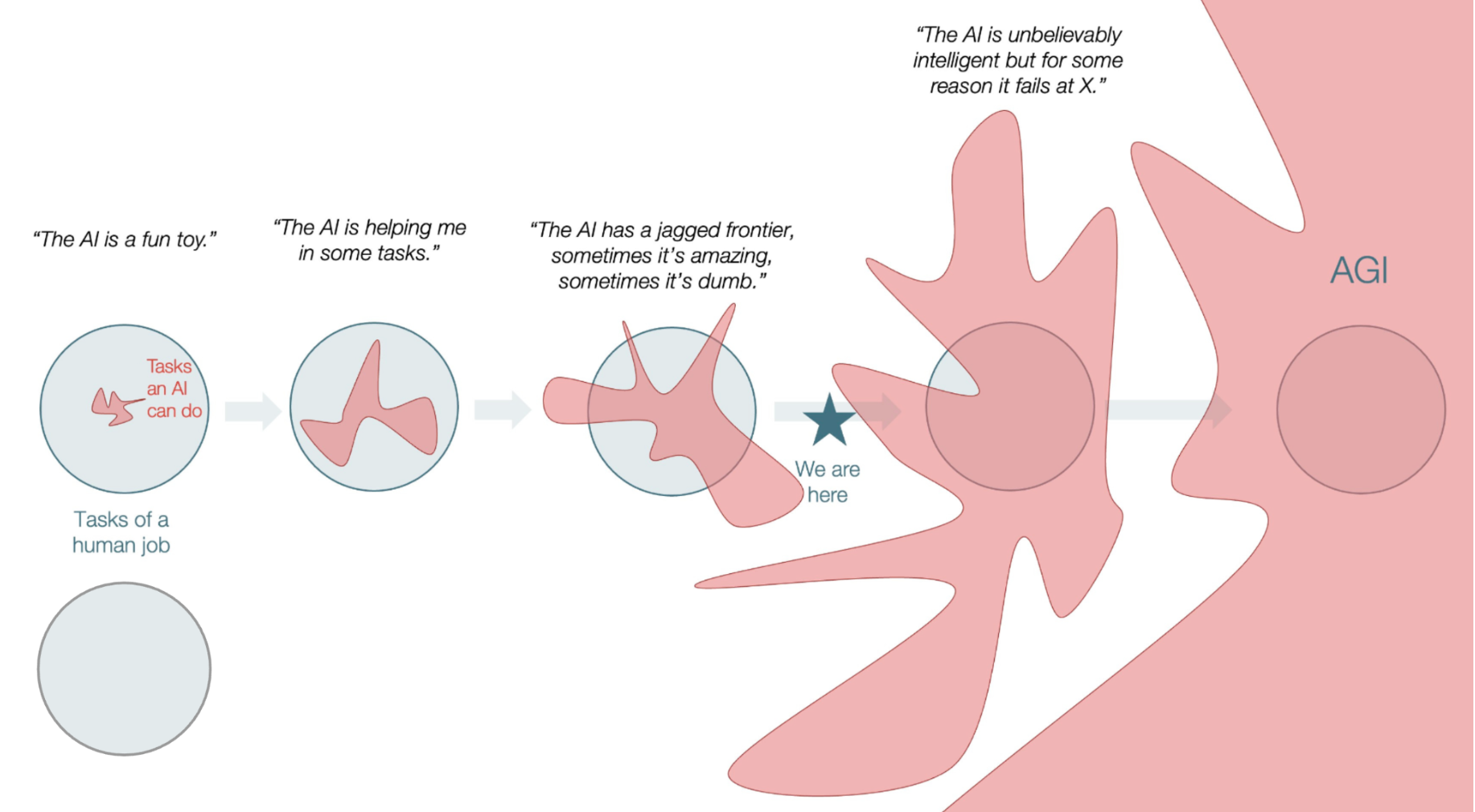
Ethan Mollick’s illustration of the jagged frontier in general. I believe in design, “We are here” would actually be further towards the left.
The jagged frontier exists for design
The jagged frontier is also very much true in digital design. At Qvik, we recently compiled our very first internal Design AI playbook. In this exercise, I led our designers in exploring their current level of perceived support from AI across different design skill categories. The outcome revealed that, in our opinion, we are readily handing off duties, such as specific UI design tasks, to AI, but nowhere near replacing the human presence in discovering internal product requirements across large stakeholder groups. Admittedly, we at Qvik only serve fewer than 20 Finnish large and medium-sized organizations in design needs, but I claim we are not alone in our observation because the so called frontier firms continue to employ designers for design work.
Take, for instance, Anthropic, one of the present-day icons in radical innovation. At Anthropic, the Head of Claude Code, Boris Cherny has stated that since late 2025, 100% of Claude Code has been written by Claude Code. And still, they are hiring more developers. Despite heavy AI use, they employ designers, and those designers use Figma. The existence of traditional tools equals the existence of traditional tasks, even if the design processes around them may have already been transformed, as their design lead Jenny Wen has proclaimed.
So, across companies and industries, digital design has not been replaced by a design AI, and many design tasks remain unique to humans.
The frontier moves two ways
One thing I believe is that the human potential will not remain unchanged as the “AI as a tool” develops. I would compare this to what happened in chess, in which AI has eventually made human players stronger. I similarly expect human designers may receive a boost to their skills, for instance, improved social awareness and human alignment through AI. For this reason, I believe that the picture of jagged frontier will look more like the following co-evolution of human and AI capability:
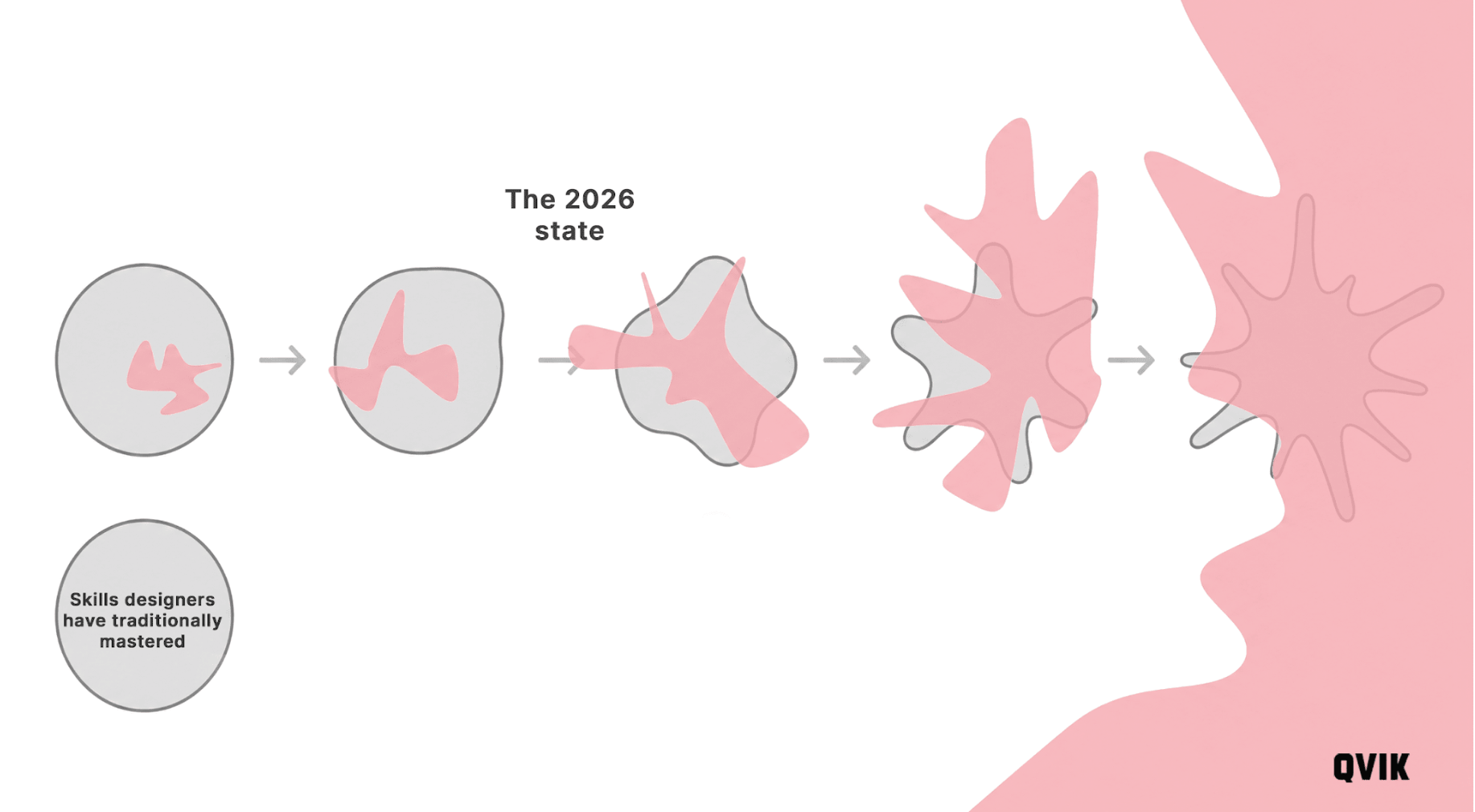
The evolving jagged frontier in which the human capacity evolves over time.
The human premium
There are additional arguments to trust human significance in the workforce. The NY Times columnist, and known AI skeptic, Ezra Klein recently took a surprisingly positive view of the AI future in his essay about AI job displacement. He argues that AI may create new demand for human work, complementing many jobs rather than replacing them, and possibly making people crave for human touch and interaction that plain AI interactions will not provide.
An AI enthusiast and podcaster Nathaniel Whittemore has presented a complementary, intriguing analysis of what he calls the human premium. This analysis has surfaced seven varieties of human premium, out of which I will focus on the aspects of trust/status, accountability, and translation that strike a chord in design.
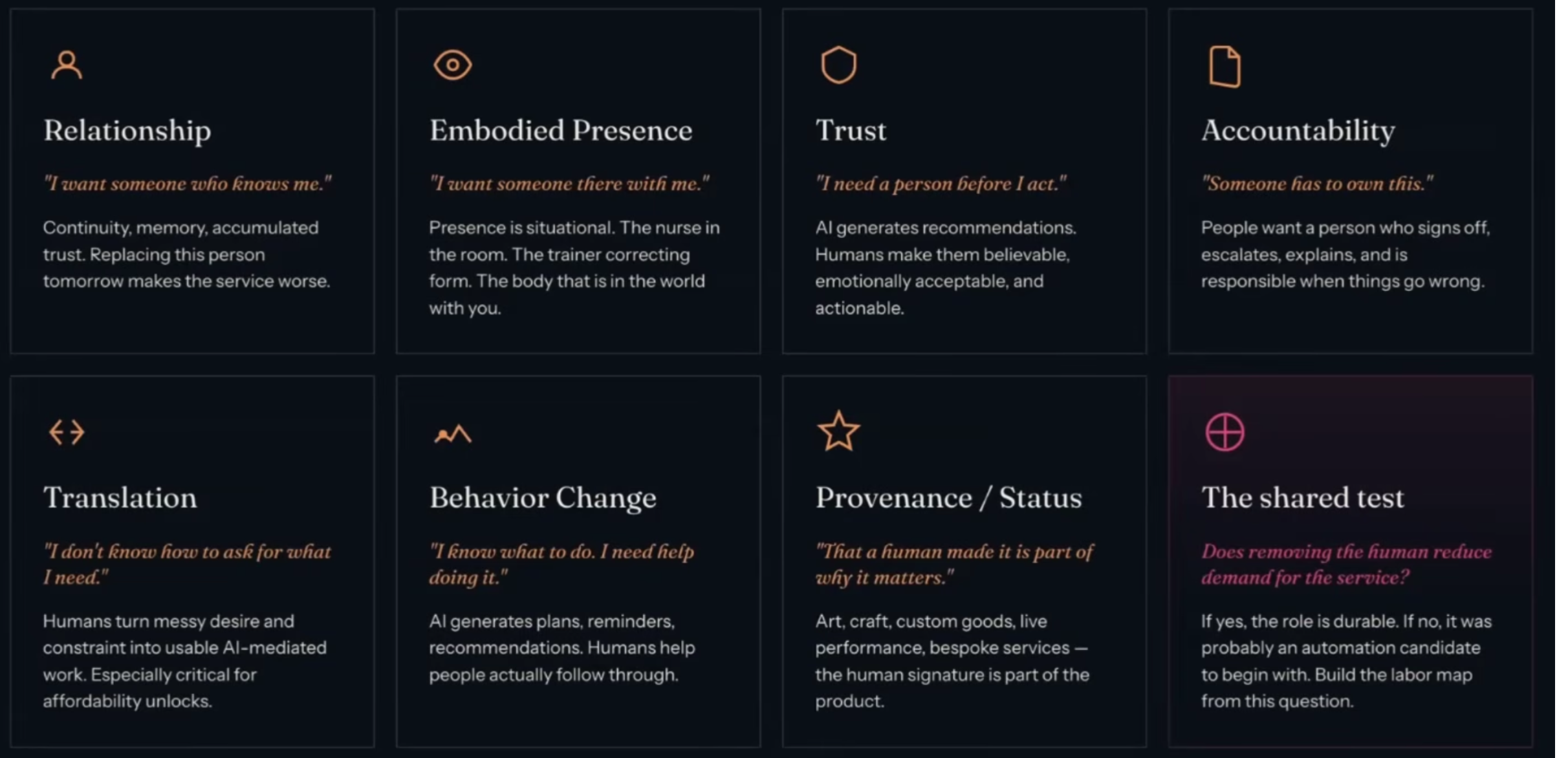
Whittemore’s proposed seven categories of human premium (AI Daily Brief: The New Jobs AI Will Create)
For any company that cares for the customer experience of their services, there must be interest ensuring favorable design outcomes. In my opinion, designers create trust in quality CX by their professional judgment (review, design critique) that must equally fall upon human and AI-created interfaces. With this power to set the tone of customer experience, comes the accountability for the same output: if sub-par interfaces are released leading to CX and business performance issues, does it help to blame AI?
The translation aspect of human premium is by far the most interesting. I think one property of great design is the skill to integrate numerous wishes and desires from users and stakeholders alike. From conflicting desires, designers can synthesize solutions that continue to feel elegant and beneficial to most users, even if they may not be exactly the thing everyone thought they wanted. More over, the translation can be based on intuition and non-verbal cues (for example, from user interviews) that AI may not be able to draw conclusions or inspiration from. Furthermore, it seems AI can’t today achieve the same things as humans even if it holds the same information
Summary: human designers prevail – for now
I strongly believe that the design profession will remain for a long time still, thanks to the edges it has over AI. Over the recent years, AI has become ever more proficient in specialist tasks – ironically conversations of artificial general and super intelligence (AGI & ASI) have been silenced or are being sidelined as AI alarmists. I remain skeptical about the prospects of developing AGI/ASI on the present track which makes me optimistic about the arguments I’ve laid in defense of the human premium in design. However, the design profession is not going unchanged and this is what I will talk about in a follow-up post about the next generation product designer.
Download our study on digital products' commercial success
Qvik combined a survey of Finnish digital leaders with global research and a review of leading Finnish digital consumer services. Download it to find out how to get more value from the digital investments you’ve already made. Did you know that 67% of Finnish digital services hide key user value behind login, for example? Explore more and get the study below.


