


Date
11 February 2026
Category
Business design, Design, Digital businessFoundation sprint: A shortcut to confident product decisions
Early moments of developing new digital offerings are critical. Decisions made at this stage have an outsized impact on success – shaping priorities, tradeoffs, and investments for years to come. Choosing the wrong path is costly to correct later, so companies consistently seek faster ways to gain clarity, reduce risk, and ensure commitment to the right decisions.


This article was written by:
Lassi Liikkanen, Director of Product Design and Insight
In short
This article explores the Foundation Sprint, a 2-day innovation method built by the creators of the 5-day Design Sprint. The article explains how the sprint aligns teams on key aspects of product strategy and why it’s often a viable option for large enterprises.
From heavy and unfeasible to rapid and adoptable
A wide range of methods has emerged to address uncertainty in the early stages of product innovation, the design sprint among the best known. In a design sprint, key decision-makers go through a highly structured, intensive process to move a new product idea to user testing in just five days. Qvik’s customers have successfully used the approach to define their minimum viable (or lovable) products under tight time constraints (see my earlier post about MVPs).
When executed well, design sprints deliver impressive results. Over time, we’ve seen that they can be difficult to run – if not hopelessly incompatible – in enterprise contexts, though. The challenge lies not in the method itself, but in how poorly it aligns with the complex organizational context.
Enterprises typically function within heavy matrix structures, placing significant demands on key individuals. Decision-makers are expected to balance multiple initiatives, stakeholder groups, and conversations at once. While five days is undeniably efficient for generating new value, asking senior stakeholders to commit is often unrealistic – at least before the organization has had time to build trust in the new idea.
The foundation sprint delivers clarity in two days
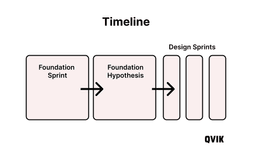
To address this challenge, the creators of the design sprint, Jake Knapp and John Zeratsky, developed a new innovation method: the foundation sprint. It’s a fast-paced, two-day process designed to stand on its own or to serve as a precursor to more intensive efforts, such as a design sprint.
The foundation sprint’s primary strength is its focus. It helps teams build a shared understanding of what they are trying to achieve, and why. Clarity helps teams minimize the risk of committing to the wrong initiatives.
The founding hypothesis answers fundamental product questions
The goal of the foundation sprint is deceptively simple. At its core is the creation of a founding hypothesis, containing the answers to five fundamental product questions:
- Who is the customer?
- What is the customer’s problem?
- How are we helping the customer?
- What is the competition like?
- How is our solution better than the competition?

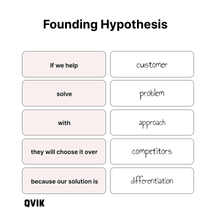
The hypothesis only appears simple once the answers to these questions are known. The secret of the foundation sprint lies in how this insight is surfaced and aligned. As the name suggests, the output is a hypothesis – not a final verdict, but a well-founded starting point.
Foundation sprint process and its key principles
The foundation sprint unfolds over two days (or roughly ten hours of intensive work), through a series of carefully combined and logically sequenced exercises that systematically build toward the founding hypothesis. Rather than paraphrasing the entire book, I’ll highlight a couple of key attributes that help explain why the method is particularly good for enterprise environments.

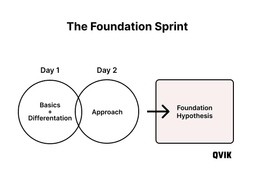
Built-in decision-making The first advantage of the foundation sprint is the team composition. The team is intentionally small, but even the smallest team must have a clearly designated decision-maker. While the sprint techniques are inclusive by design, actual progress depends on someone taking ownership of key decisions.
Structured ideation without groupthink Another core strength of the foundation sprint is its so-called note-and-vote approach to ideation and decision-making – meaning that the team works “alone together.”
Although that might sound depressing, it is actually fun – especially because of the value it provides. Traditional group brainstorming is known to be inefficient for many reasons, including social loafing, anxiety, regression to the mean, and production blocking. Note-and-vote avoids these pitfalls by using scientifically proven best practices for idea generation before groupthink mode. Team members get to work independently first, then share and vote on ideas.

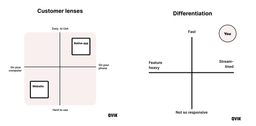
Making differentiation visible Finally, the foundation sprint includes enlightening, practical tools for evaluating ideas through multiple lenses. These tools offer an elegant way out of conversations that stall because teams struggle to compare ‘apples and oranges’.
The authors suggest using simple 2×2 matrices to visually compare your product ideas and explore paths to differentiation. They help discover crucial dimensions where your new product can – and should – stand out from the competition.

Move forward with confidence in enterprise digital product innovation – we’ll help
The foundation sprint can act as a significant enabler for innovation, offering a pragmatic alternative without heavy time commitments in early product innovation. It fits naturally into enterprise schedules, while answering key questions that determine long-term success.
Whether used on its own or as a precursor to a design sprint, the foundation sprint is an effective way to reduce risk in early stages. To run it, you only need a focused core team and a skilled facilitator.

Our early experiences running foundation sprints have both been invigorating and highly effective in helping teams gain clarity. If you’re navigating the uncertainty of a new digital initiative, we’re happy to help you with this new, value-focused way of working, or find an alternative approach that can help you advance.
Get in touch and let’s sprint together!