Building better products faster
At Qvik, AI is part of how we build products every day. It helps us move faster, keep quality high, and get more done. We bring solid experience and practices for AI-augmented development and product design, and we always adapt our approach to fit each client's environment, security requirements, and ways of working.


Many of our clients operate in regulated industries where data privacy and compliance come first. So for us, responsible AI usage and data security are always the starting point. We work with our clients to understand their specific constraints and make sure our tooling and workflows respect them before we get started.
In practice, our developers are experienced with state-of-the-art AI coding agents that assist across the full development lifecycle: writing and refactoring code, debugging, generating tests, and navigating complex codebases. These tools can be connected to project management, error tracking, logging, and design systems, giving the AI real context about the work at hand. Beyond the individual developer workflow, we have experience using background agents for well-scoped tasks and leveraging built-in AI capabilities in project management tools to streamline delivery.
Our product designers are trained to use AI tools flexibly, tailored to specific situations. We have developed a good sense of which design tasks are most susceptible to augmentation and which require more human agency. With the help of AI-generated rapid prototypes and AI-assisted design research, we can guide our design resources more effectively to bear upon the critical UX and business design questions that enable building successful products.
Our approach is tool-agnostic: we continuously evaluate and adopt whichever tools represent the current state of the art, and we’re happy to work within the client’s existing toolchain or recommend improvements where it makes sense.
What makes it work
1. Strong technical foundations
AI tools amplify the quality of what's already there. Projects with clean architecture, well-defined APIs, consistent patterns, and solid documentation get dramatically more value from AI assistance. Part of our consulting approach is helping clients build or improve these foundations.
2. Skilled experts in the driver's seat
AI doesn't replace judgement. Our skilled consultants direct the tools, evaluate output, and make the decisions. The result is faster delivery without compromising on quality or maintainability.
3. Structured, integrated workflows
The real leverage comes when AI is connected to the tools and context that surround the code, not used in isolation. We invest in setting up these integrations properly for every project.
Responsible AI usage
We take a deliberate, security-first approach to AI in professional delivery. Many of our clients handle sensitive customer data, operate under regulatory frameworks, or have strict policies around data processing and third-party tooling. Before introducing AI tools into any engagement, we align on data handling practices, make sure we’re in line with the client’s security policies, and configure tools to respect data boundaries. No client data is fed into AI systems without explicit agreement and appropriate safeguards in place. All AI-generated output goes through human review before it reaches production. AI is a powerful accelerator, but accountability stays with our people. We’re also happy to advise on how to work with AI in a secure way.


Connected AI
A key part of our setup is MCP (Model Context Protocol), an open standard that lets AI tools connect securely to external systems. Through MCP servers, our developers’ AI assistant can read tasks from project management tools, inspect error logs in Sentry, pull design specs from Figma, query documentation, and more. All within the same workflow. This means the AI operates with real project context rather than working in a vacuum, which makes a big difference in the relevance and accuracy of its output.

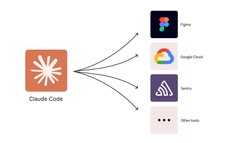
By connecting the AI agent to other tools we reach maximum effect.
Background agents
For well-defined, scoped tasks (implementing a straightforward feature from a detailed spec, fixing a documented bug, writing test coverage) we use background agents that work autonomously and deliver a pull request for review. This lets our teams parallelise work in ways that weren’t previously possible. A developer can focus on complex architectural work while a background agent handles three smaller tickets at the same time. The result is higher throughput without growing headcount, and faster turnaround for our clients.

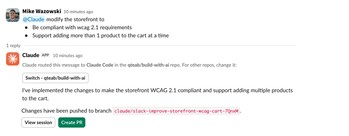
The image shows an example of starting a background agent from Slack.
Our client cases
Now you know how we work. Time to check out what we deliver as well.


Do you want to know more about how we work with AI?
Robert Seege, Sales Director